


The right photo storage box depends on whether your main goal is organization, frequent access, display, or long-term preservation. A clear plastic photo organizer case with 16 individual compartments is excellent for sorting hundreds of 4×6 prints, but it solves a different problem from a preservation-quality box intended for older family photographs.
The products below are compared by photo size, capacity, material, internal organization, closure, portability, stackability, and documented preservation-related claims. That makes it easier to separate boxes built mainly for everyday organization from products intended for longer-term photo storage.
Affiliate disclosure: this article contains affiliate links. If you buy through an eligible link, Craft Ideas may earn a commission at no extra cost to you.
Best Photo Storage Boxes — Quick Picks
Jump to:
| Best for | Product | Photo size | Storage style |
|---|---|---|---|
| Best overall organizer | IRIS 4×6 Photo Keeper | 4×6 | 16 individual cases inside a carry case |
| Best large-capacity 4×6 organizer | Novelinks Photo Storage Box | 4×6 | 16 individual cases; retailer-listed capacity up to 1,600 prints |
| Best cardboard photo box | Pioneer Photo Storage Box | Up to 4×7 | Acid-free board box with dividers and label holder |
| Best archival-focused option | University Products Archival Photo Storage Box | Varies by exact box | Preservation-oriented box/enclosure system |
| Best wide craft organizer | ArtBin Semi Satchel | Mixed sizes / craft storage | Stackable polypropylene case with removable dividers |
| Best colorful plastic organizer | Recollections Photo & Craft Keeper | 4×6 | 16 individual photo cases |
| Best compact organizer case | Advantus Photo Keeper | 4×6 | 6 individual cases; up to about 600 prints |
| Best decorative wooden box | ArtMinds Wooden Photo Box | Depends on exact print/enclosure | Decorative wood keepsake box |
Which Photo Storage Box Should You Choose?
| Your goal | What to prioritize | Good match from this roundup |
|---|---|---|
| Organize hundreds of 4×6 prints | Individual cases, labels, clear visibility | IRIS, Novelinks, Recollections |
| Frequently access family photos | Easy-open cases and visible categories | IRIS, Advantus |
| Long-term preservation | Verified photo-safe / archival materials and suitable environment | University Products; Pioneer for acid-free board storage |
| Store mixed craft and photo items | Adjustable dividers and larger internal space | ArtBin Semi Satchel |
| Display a box on a shelf | Decorative finish and convenient access | Pioneer or ArtMinds, depending preservation needs |
| Move photos between rooms or events | Outer handle, secure closures, individual cases | IRIS, Novelinks, Recollections |
| Store valuable old photographs | Preservation-quality enclosures, stable environment, minimal handling | Archival-focused system rather than a generic organizer |
The most important distinction is organization versus archival storage. A product can be excellent at sorting and transporting photos without having the documentation needed for preservation-focused storage. Conversely, an archival box may protect a collection well but be less convenient when you want to browse photos every weekend.
How We Chose These Photo Storage Boxes
These photo storage boxes are compared using documented photo-size compatibility, capacity, material claims, compartment design, closures, portability, stackability, labeling, and suitability for different storage goals.
Archival claims receive extra scrutiny. A cardboard box is not automatically archival because it is white or acid-free, and a plastic organizer is not automatically photo-safe because it is clear. For long-term preservation, the Library of Congress recommends photo enclosures that meet appropriate physical and chemical specifications and notes that the Photographic Activity Test (PAT) is an important indicator for materials intended to contact photographs.
The 8 Best Photo Storage Boxes Reviewed
IRIS 4×6 Photo Keeper — Best Overall Photo Organizer Case
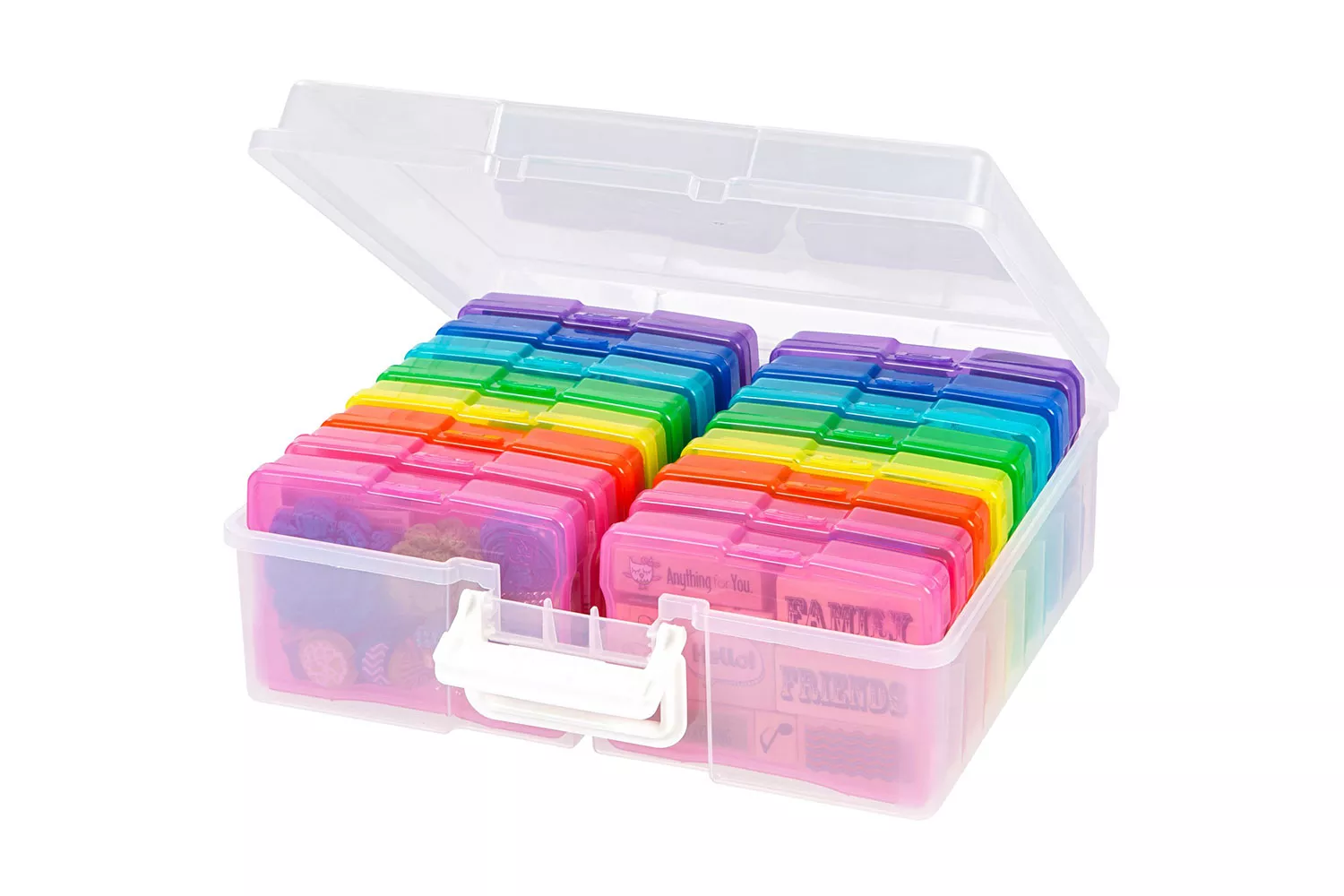
Best for: families with large numbers of standard 4×6 prints, teachers, crafters, and anyone who wants photos divided into removable categories.
IRIS sells several 4×6 Photo Keeper configurations. The 16-case version uses an outer carry case that holds 16 removable photo cases. IRIS says each individual case can hold up to 100 standard 4×6 prints, giving the familiar organizer layout used for years, events, family members, trips, school years, or craft categories.
The strongest reason to choose IRIS over a generic case is documentation. IRIS identifies the plastic as BPA-free, acid-free, PVC-free, and lignin-free, with recycle #5 material. The company also documents snap-tight closures, rounded inner-case corners, and a molded carrying handle.
That makes it a strong photo organizer case. It is still important not to overstate what those claims mean: for highly valuable or historically important photographs, preservation guidance should consider the exact print type, enclosure, and storage environment rather than relying on the word “acid-free” alone.
Main limitation: it is designed around 4×6 organization. Larger 5×7 or 8×10 prints need another format.
Check current IRIS Photo Keeper options on Amazon
Novelinks Photo Storage Box — Best Large-Capacity 4×6 Organizer
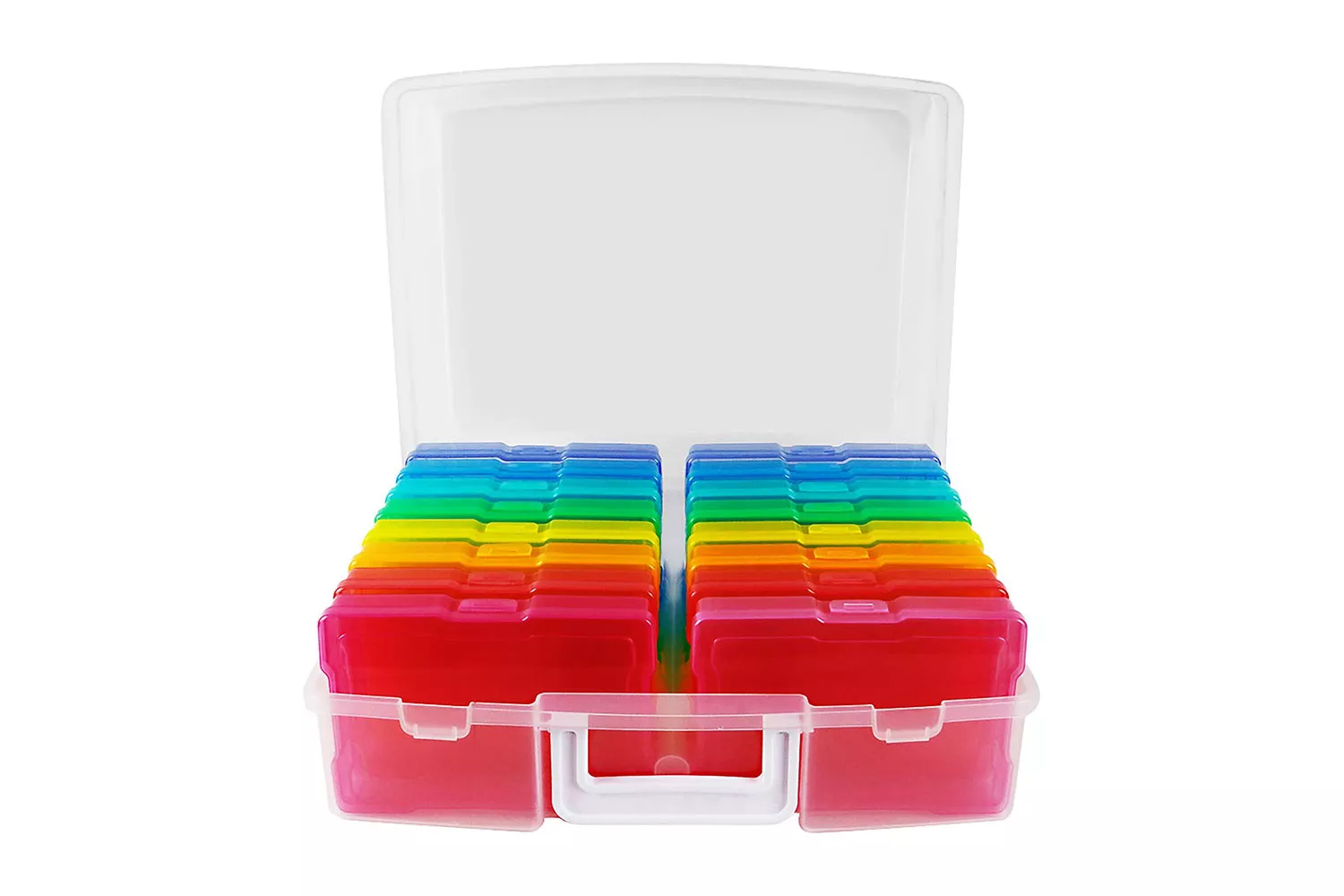
Best for: large family print collections that need many separate categories in one portable case.
The Novelinks 16-case organizer is widely listed with 16 individual 4×6 cases, each designed for roughly 100 prints, for a total advertised capacity of up to 1,600 photos. Retailer listings put the outer case around 14.8 × 12 × 5.1 inches.
The use case is straightforward: one inner case can hold “2019,” another “School,” another “Grandparents,” and so on. You can remove one category without disturbing the rest of the collection, and the clear or colored cases make identification faster than flipping through one large undivided box.
I would choose it for organization and access, not because of an unverified archival claim. Listings document the modular plastic design and capacity, but reliable first-party documentation for the exact storage-material chemistry is limited.
Main limitation: it is best suited to 4×6 organization rather than preservation-focused storage.
Check current Novelinks size and availability on Amazon
Pioneer Photo Storage Box — Best Cardboard Photo Storage Box
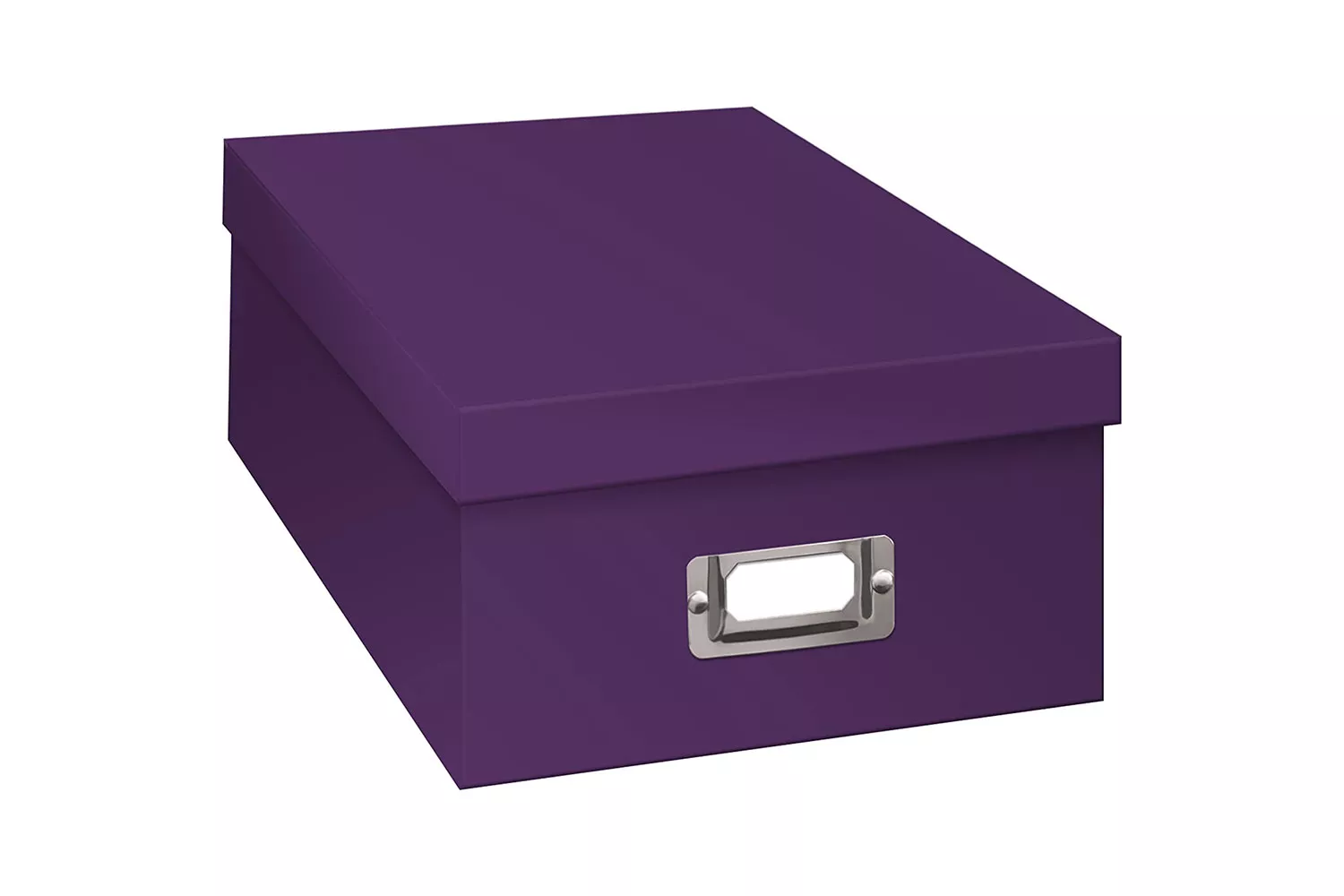
Best for: loose prints, simple shelf organization, people who prefer an opaque labeled box, and collections up to about 4×7.
Pioneer’s photo-box line remains a useful alternative to plastic compartment cases. Product information lists acid-free board construction, a metal identification holder, divider cards, and capacity for more than 1,100 prints up to 4×7 inches on common B1 variants.
The important advantage is simplicity. Instead of 16 small cases, you get one labeled box that can be divided by event or date. Opaque board also keeps the contents out of incidental light while stored.
Pioneer is especially relevant to the cardboard photo storage boxes cluster because it demonstrates why “cardboard” is not one category. Generic cardboard and a product specifically sold as acid-free photo-storage board should not be treated as equivalent.
Main limitation: the box is organized with dividers rather than individual snap cases, so it is less convenient for frequently pulling out one self-contained photo group.
Check current Pioneer Photo Storage Box options on Amazon
University Products Archival Photo Storage Box — Best Archival-Focused Option
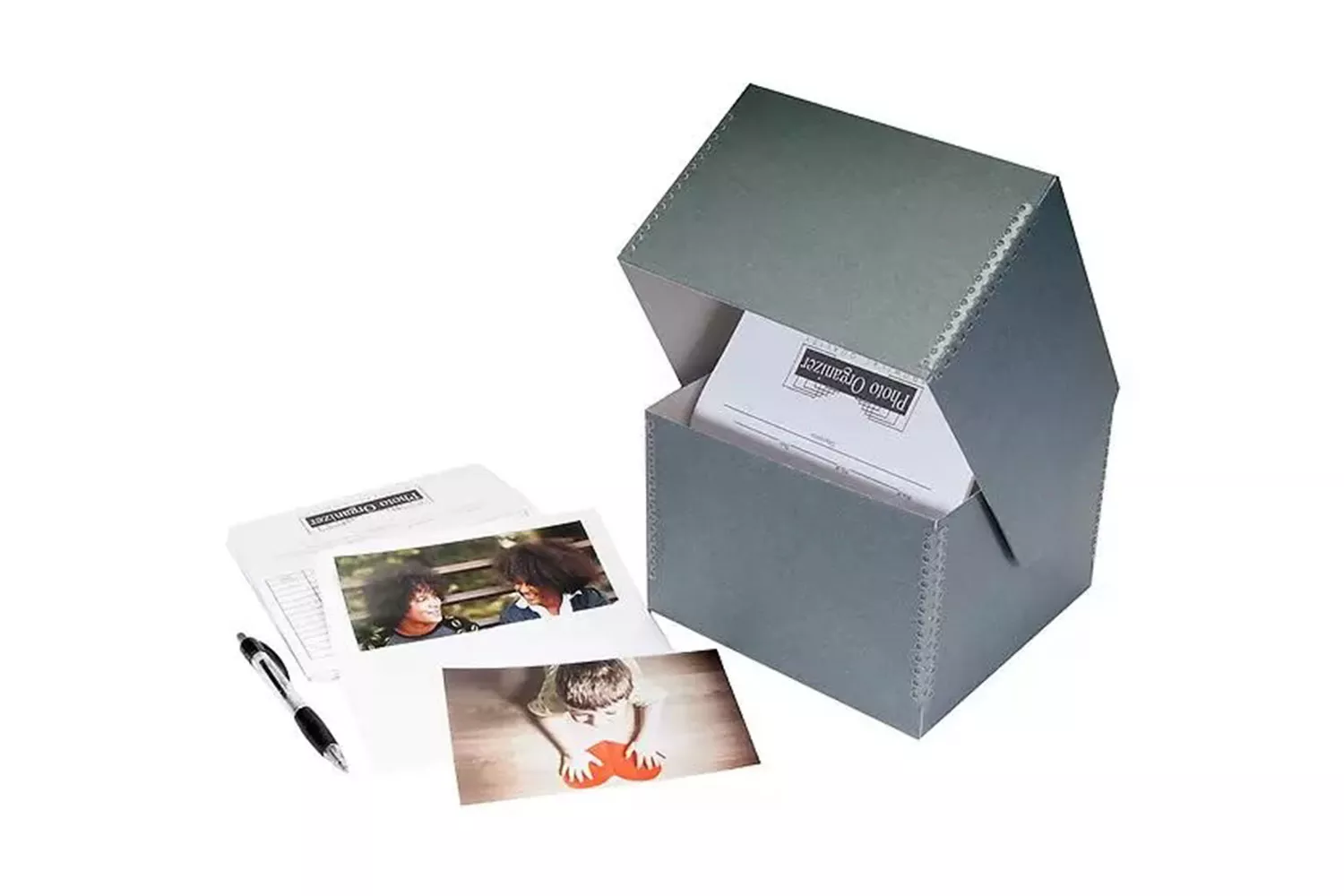
Best for: older family photographs and collections where preservation documentation matters more than portability or decorative design.
University Products specializes in preservation supplies rather than general household organizers. The company documents archival photo boxes, sleeves, and enclosures made for photographic materials and explains that many of its archival box materials and related photo-storage products are evaluated using the Photographic Activity Test.
University Products offers archival photo boxes and matching enclosures in multiple sizes, so the box and enclosure dimensions should be matched to the photographs being stored. For older or valuable prints, choosing the correct enclosure size is more important than maximizing capacity.
This is the product category to study when “archival” is your real requirement. The focus is not rainbow dividers or carrying handles; it is documented enclosure material and preservation use.
Main limitation: less convenient for casual browsing, and exact size/package configuration must be matched carefully to your prints.
ArtBin Semi Satchel — Best Wide Box for Photos + Craft Materials
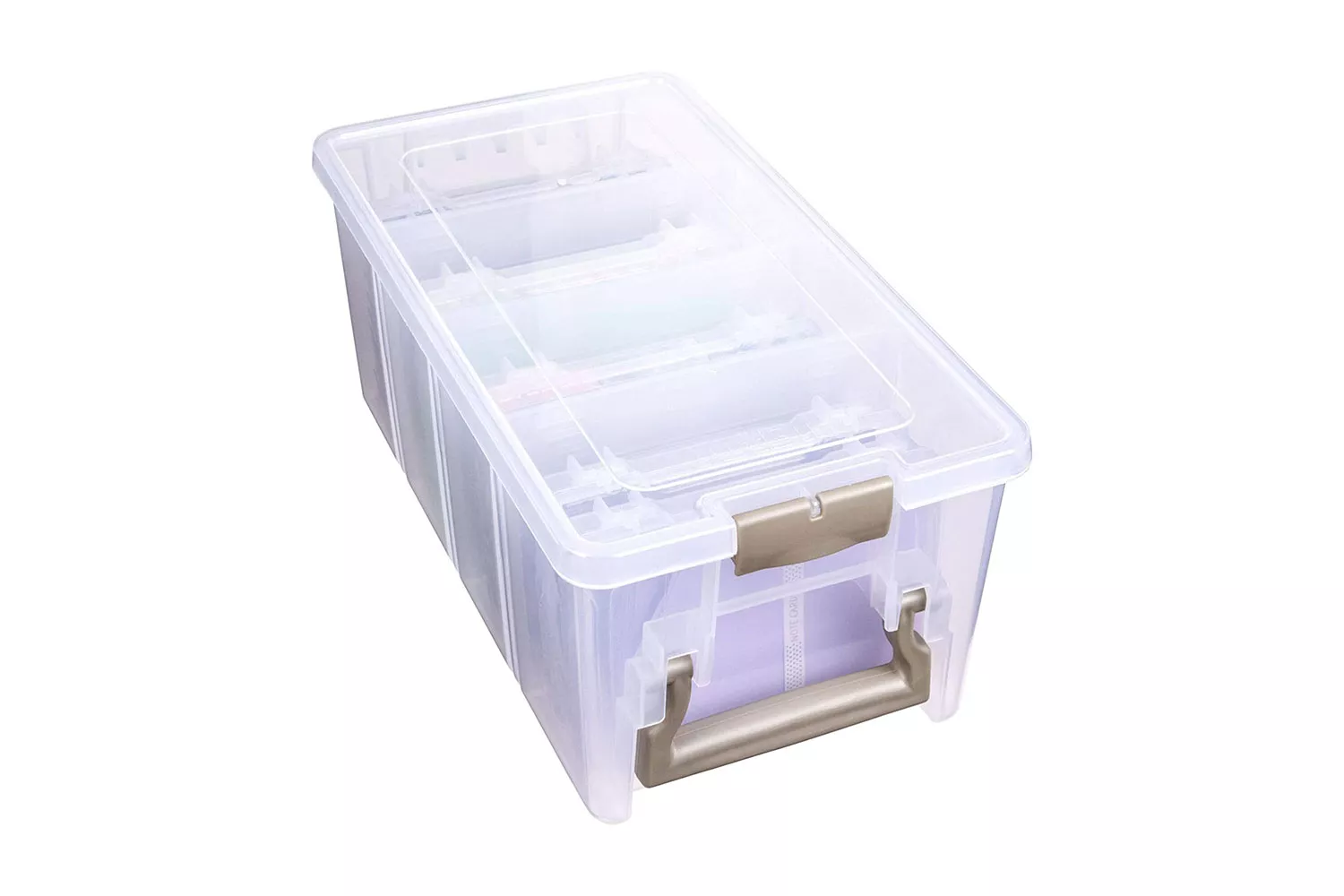
Best for: mixed-size photo projects, scrapbook supplies, paper ephemera, and users who need adjustable dividers rather than individual 4×6 cases.
ArtBin describes the Semi Satchel as a stackable translucent polypropylene case measuring about 15.25 × 8 × 6.25 inches with three removable dividers. This makes it a flexible storage container, but not the same product format as a dedicated 16-case photo organizer.
Some ArtBin listings are sold as bundles with additional organizers or accessories, while others include only the Semi Satchel. Check the exact package contents when comparing listings so you are comparing the same configuration.
For crafters, the adjustable interior is useful because a photo project rarely contains only prints. You may also be storing envelopes, journaling cards, stickers, keepsakes, or cutting-machine leftovers.
Main limitation: if you only want to sort 4×6 prints by year, dedicated individual photo cases are more efficient.
Check current ArtBin Semi Satchel options on Amazon
Recollections Photo & Craft Keeper — Best Color-Coded Plastic Organizer
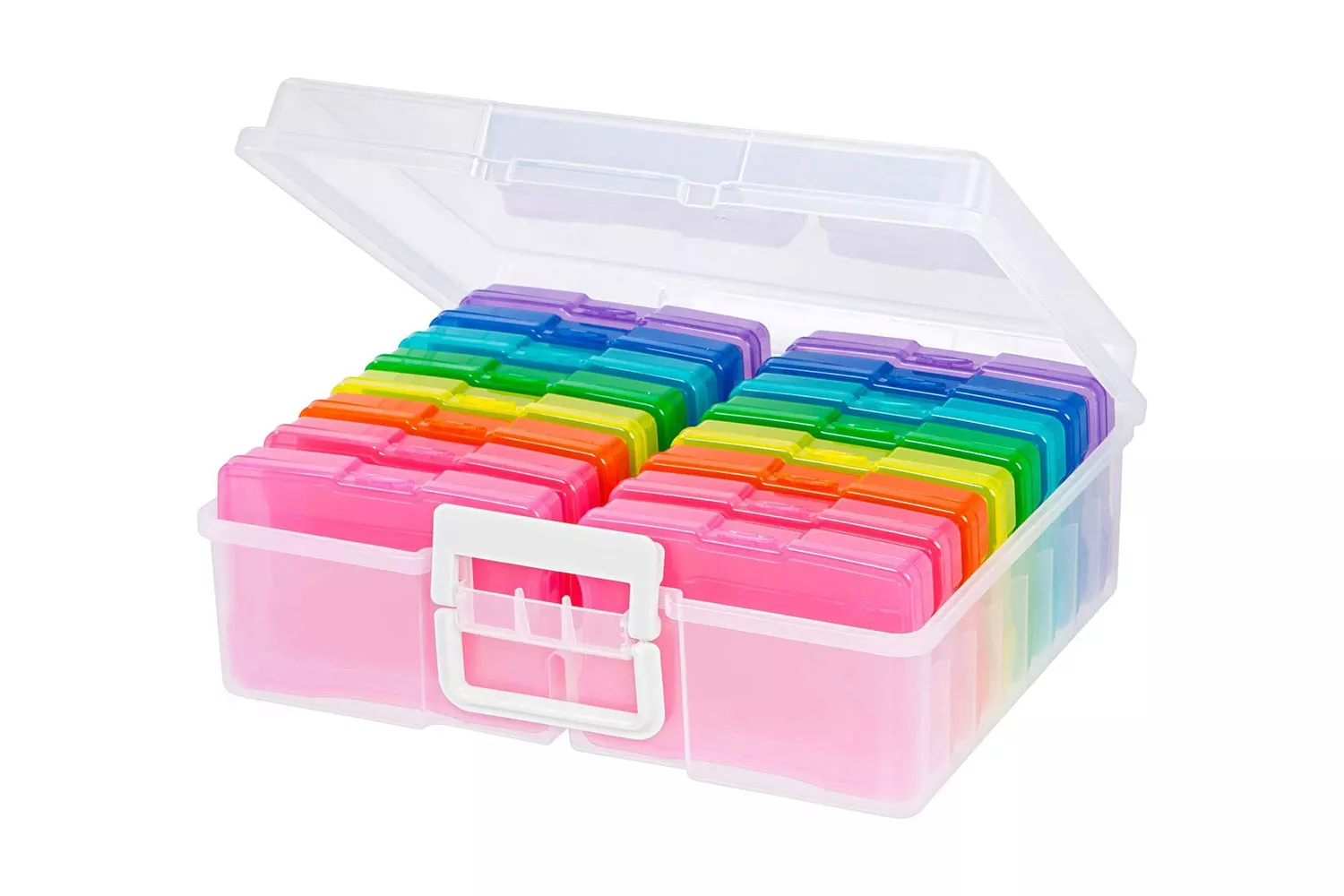
Best for: visual organization, family photo sorting, classroom materials, and crafters who want multiple removable cases.
The Recollections 16-case organizer is documented as a large outer box with 16 small cases, each holding up to about 100 4×6 photos. Listings describe an overall size around 15 × 12 × 5 inches, small cases around 7 × 5 × 1.2 inches, and acid-free plastic construction.
The 16-case Recollections organizer is designed for 4×6 prints. Its removable cases make it easy to separate photos by year, person, trip, school year, or another category.
The color-coded cases make it easy to create a simple family system—one color for each child, decade, trip, or event. The carrying handle and stackable outer form also make it practical for craft rooms.
Main limitation: the individual cases are 4×6-oriented, so do not buy this specific configuration expecting full 5×7 storage.
Check current Recollections Photo & Craft Keeper availability on Amazon
Advantus Photo Keeper — Best Compact Photo Organizer Case

Best for: smaller collections and anyone who likes the individual-case system but does not need a 16-case outer box.
The Advantus Photo Keeper model 61989 uses six individual 4×6 cases inside one clear outer keeper. Retailer documentation for this model lists about 100 prints per case, for a total capacity of around 600 4×6 photos.
With six individual cases holding about 100 standard 4×6 prints each, the organizer is designed for a total capacity of roughly 600 photos under the listed loading assumptions.
The six-case format is easier to fit into a smaller cupboard and is useful when you only need categories such as family, travel, school, holidays, friends, and favorites.
Main limitation: availability is limited compared with newer 4×6 organizer systems.
Check current Advantus Photo Keeper availability on Amazon
ArtMinds Wooden Photo Box — Best Decorative Photo Storage Box
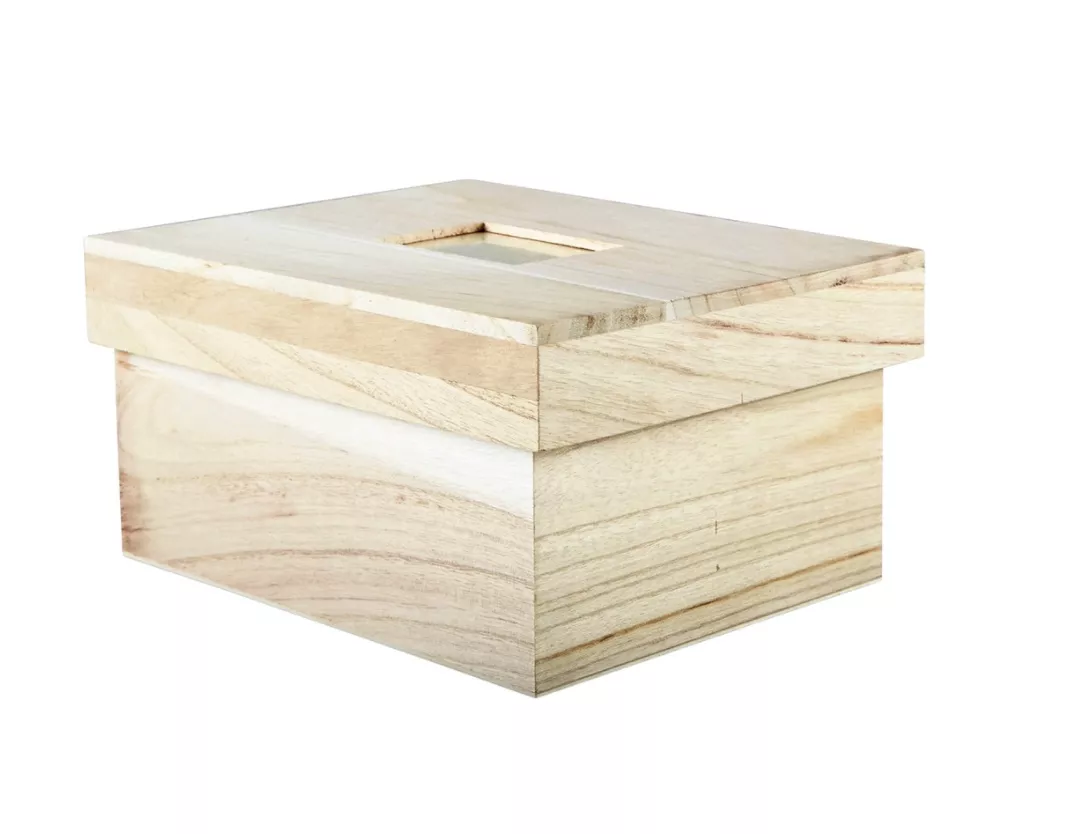
Best for: shelf display, gifts, keepsakes, and DIY customization where appearance is more important than verified archival performance.
The unfinished ArtMinds wooden photo box is the most decorative choice in this lineup. It can be painted, stained, labeled, or personalized, which makes it useful for wedding photos, baby keepsakes, or a family memory box.
It should not be treated as an archival recommendation simply because it is sturdy or made from wood. Wood is not automatically photo-safe, and direct contact materials matter for long-term preservation. If valuable photographs will live in a decorative wooden box, place the prints in verified photo-safe sleeves or envelopes first.
Main limitation: decorative value is the main strength; preservation claims are not the reason to choose it.
Check current ArtMinds Wooden Photo Box availability on Amazon
Best Photo Storage Box for Long-Term Storage
Long-term photo storage is less about buying the box with the strongest marketing language and more about combining appropriate enclosure materials with a stable environment.
The Library of Congress recommends protective photo enclosures that meet appropriate physical and chemical standards and notes that photo-safe materials may be paper or certain stable plastics. It also emphasizes that storage environment is one of the most important preservation factors.
For valuable old family prints, consider:
- photo-safe primary sleeves or envelopes when appropriate;
- a preservation-quality outer box;
- minimal handling of image surfaces;
- a cool, relatively dry, stable interior location;
- limited light exposure;
- avoiding areas with leak risk or large temperature/humidity swings.
For preservation guidance beyond ordinary household organization, see the Library of Congress guidance on care and storage of photographs.
Best Archival Photo Storage Boxes: What “Archival” Should Mean
“Archival” should describe documented materials and suitability for photographic storage—not simply a white cardboard box or a premium-looking label.
Preservation suppliers often reference the Photographic Activity Test (PAT), which evaluates interactions between storage/display materials and photographic materials. University Products explicitly discusses PAT-tested products in its archival photo-storage guidance.
For ordinary family organization, you may not need museum-style storage for every snapshot. But for historically valuable, irreplaceable, or fragile photographs, stronger material documentation becomes much more important.
Are Acid-Free Photo Storage Boxes Better?
Acid-free is useful, but it is only one part of photo-storage quality. Paper and board products can also involve lignin, dyes, coatings, buffering, adhesives, and other components. Likewise, plastic storage quality depends on the polymer and additives, not on whether the box is transparent.
The Library of Congress specifically warns that an “acid-free” label by itself does not answer every preservation question. For significant photographs, look for products that clearly document photo-safe materials or relevant testing.
Plastic Photo Storage Boxes: Advantages and Trade-Offs
Plastic photo organizers are popular because they make categories easy to see, wipe clean, carry, and stack. Individual cases are particularly useful when you regularly access prints.
Advantages
- Clear visibility.
- Removable individual cases.
- Easy labeling.
- Good portability.
- Simple wipe-clean surfaces.
- Useful for craft supplies as well as prints.
Trade-offs
- Not every plastic has the same preservation properties.
- A tight lid does not fix a humid storage environment.
- Scratch resistance and latch durability vary by product.
- Many compartment systems are limited to 4×6.
Are Plastic Boxes Safe for Old Photos?
It depends on the plastic and the storage environment. The Library of Congress identifies uncoated polyester, polyethylene, and polypropylene as commonly suitable plastic enclosure materials for many photographic uses, while warning against PVC and unknown plastics.
High humidity is still a problem. Photographic emulsions can adhere to plastic under poor environmental conditions, so a plastic container should never be treated as permission to store important photos in a damp basement or hot attic.
Cardboard Photo Storage Boxes
Cardboard boxes can be lightweight, easy to label, inexpensive, and simple to stack. Pioneer’s acid-free board photo box is a good example of a cardboard product designed specifically for photo storage.
But generic cardboard is not the same as archival board. A shipping box, decorative shoebox, and preservation-quality photo box may all look similar from the outside while using very different materials.
If long-term preservation matters, check the manufacturer’s material specifications rather than relying on the word “cardboard.”
Decorative Photo Storage Boxes
Decorative photo boxes prioritize accessibility and presentation. Linen-look boxes, printed cardboard boxes, and wooden keepsake boxes can look better on a shelf than clear plastic organizers.
That makes them useful for gifts, recent family photos, and collections you want nearby. It does not automatically make them the right choice for direct long-term contact with valuable old prints.
For a decorative box with uncertain contact materials, use verified photo-safe sleeves or envelopes inside.
Best Photo Organizer Case
The term photo organizer case usually describes the outer-case-plus-inner-cases format used by IRIS, Novelinks, Recollections, and Advantus. It is one of the best systems for people who care more about sorting and retrieval than museum-style archival storage.
Individual cases let you organize by:
- year;
- event;
- person;
- family branch;
- vacation;
- school year;
- duplicates to digitize;
- photos waiting for scrapbook projects.
IRIS stands out in this format because its product documentation clearly publishes case count, dimensions, material claims, and 4×6 capacity.
Photo Storage Case vs Photo Storage Box
| Term | Usually emphasizes | Typical example |
|---|---|---|
| Photo storage case | Portability, latches, plastic, compartments | IRIS 16-case keeper |
| Photo storage box | Broader category: board, archival, decorative, wood, plastic | Pioneer board box or archival photo box |
These are shopping-language tendencies, not strict dictionary definitions. Many retailers use “case,” “box,” “keeper,” and “organizer” interchangeably.
Best Photo Storage Box for 4×6 Photos
| Product | 4×6 compatible? | Organization format | Approx. stated capacity |
|---|---|---|---|
| IRIS 16-case Photo Keeper | Yes | 16 individual cases | Up to 1,600 |
| Novelinks 16-case organizer | Yes | 16 individual cases | Up to 1,600 |
| Recollections 16-case keeper | Yes | 16 individual cases | Up to 1,600 |
| Advantus Photo Keeper | Yes | 6 individual cases | Up to about 600 |
| Pioneer Photo Storage Box | Yes | Divider cards in one box | 1,100+ up to 4×7 |
Manufacturer or retailer capacity numbers assume a particular print thickness and loading method. Sleeves, envelopes, thick photo paper, or labels can reduce practical capacity.
Best Photo Storage Box for 5×7 Photos
Do not assume a 4×6 organizer can stretch to 5×7. Individual inner cases are sized tightly around their intended format.
IRIS offers a separate 5×7 Photo Keeper case format, which is a better approach than forcing 5×7 prints into a 4×6 organizer. For mixed or larger prints, a divided open box or archival enclosure sized for the actual photograph can be more practical.
For 5×7 prints, use a dedicated 5×7 case or a larger box with documented interior dimensions rather than a 4×6 compartment organizer.
Photo Storage for 8×10 Prints
Most individual photo organizer cases in this roundup are too small for 8×10 prints. For portraits, school photos, and larger family prints, choose a box or enclosure whose interior dimensions are explicitly larger than the print.
For significant older 8×10 prints, preservation-oriented sleeves or folders inside a properly sized photo-safe box are more appropriate than bending or forcing the print into a compartment case.
What Size Photo Storage Box Do You Need?
- 4×6: individual photo keeper systems are widely available and easy to organize.
- 5×7: choose a dedicated 5×7 case or a larger divided box.
- 8×10: use a larger box/enclosure designed around the full print dimensions.
- Mixed sizes: adjustable dividers or multiple appropriately sized enclosures work better than one rigid compartment size.
- Albums + loose prints: measure the album itself; photo-print dimensions are no longer the relevant measurement.
How Many Photos Can a Storage Box Hold?
There is no universal answer. Capacity depends on print size, paper thickness, sleeves or envelopes, dividers, and whether the product uses multiple individual cases.
Use manufacturer capacity as a planning number, not a requirement to pack every case completely full. For old or fragile photos, easy handling and avoiding pressure on the stack can matter more than maximizing count.
How to Organize Photos in a Storage Box
- Remove obvious duplicates and set aside prints you plan to digitize.
- Choose one primary system: year, event, person, or family branch.
- Keep categories broad at first. You can subdivide after the main collection is sorted.
- Label the enclosure, not the image area. This reduces repeated handling of the print.
- Use dividers or individual cases to keep groups from mixing.
- Keep written context with the collection when names, dates, or locations are known.
- Digitize irreplaceable photographs as a backup. Digital copies do not replace good physical storage, but they reduce the risk of losing the only accessible image.
Photo Storage Box vs Photo Album
| Factor | Storage box | Album |
|---|---|---|
| Capacity | Usually higher | Usually lower |
| Browsing | Requires removing a group or case | Easy sequential viewing |
| Organization | Flexible categories/dividers | Page order |
| Adding new photos | Usually easy | Depends on page layout/binding |
| Preservation quality | Product/material dependent | Product/material dependent |
Neither format is automatically more archival. Materials, enclosure design, handling, and environment matter in both.
Where Should You Store Photo Boxes?
For ordinary household collections, choose an interior location that stays relatively cool, dry, clean, and stable. Keep photos away from direct sunlight, leaks, radiators, exterior-wall condensation, and areas with major temperature swings.
The Library of Congress specifically advises against attics and basements for valuable photographs because those spaces often experience temperature/humidity instability and higher water risk.
Should Photos Be Stored in Basements or Attics?
Not when long-term preservation matters. A plastic bin does not cancel out extreme heat, high humidity, condensation, or flood risk. The Library of Congress notes that even stable plastics do not protect collections from environmental extremes in basements, attics, or garages.
What Makes a Good Photo Storage Box?
- Correct size: the photo should fit without bending.
- Documented material: especially important for direct contact and long-term preservation.
- Secure closure: useful for dust protection and portability.
- Organization: dividers or individual cases that match how you retrieve photos.
- Labeling: categories should be identifiable without unnecessary handling.
- Stackability: useful, but do not overload fragile containers.
- Capacity: enough for your collection without forcing or compressing prints.
- Portability: handles matter if the collection moves often.
- Archival/photo-safe documentation: important when preservation is the priority.
- Environment compatibility: no box compensates for consistently poor storage conditions.
Photo Storage Box FAQ
What are the best photo storage boxes?
The best photo storage box depends on your goal. For 4×6 organization, IRIS and similar individual-case organizers are convenient. For labeled cardboard storage, Pioneer is a strong option. For preservation-focused storage of older photographs, choose products with clear photo-safe or archival documentation rather than relying only on appearance.
What kind of box is best for storing photos?
For everyday organization, choose a correctly sized photo organizer with secure closures and useful dividers. For valuable older photographs, prioritize documented photo-safe materials and suitable primary enclosures. The storage environment—cool, relatively dry, stable, and away from light and water risk—is also important.
Are plastic boxes safe for photo storage?
They can be. Preservation authorities commonly recognize stable plastics such as uncoated polyester, polyethylene, and polypropylene for many photo-storage uses. Avoid unknown plastics and PVC for direct archival contact. High humidity remains a concern even when the plastic itself is suitable.
Should photo storage boxes be acid-free?
Acid-free is a useful feature for paper/board storage, but it is not the only preservation criterion. Lignin, dyes, coatings, adhesives, buffering, and PAT/photo-safe documentation can also matter. For valuable prints, look beyond one marketing phrase.
Is cardboard safe for storing photos?
Some cardboard products are specifically made for photo storage and documented as acid-free or preservation quality; generic cardboard is not equivalent. Pioneer’s photo storage boxes are one example of board products sold specifically for photographs.
What is the best way to store 4×6 photos?
If easy access is the priority, individual 4×6 cases inside a larger keeper make sorting simple. For preservation-focused collections, use properly sized photo-safe sleeves/envelopes and boxes suited to the photograph type and environment.
How many 4×6 photos fit in a storage box?
It depends on the product. Many individual 4×6 keeper cases are advertised for around 100 prints each, while 16-case systems may advertise up to 1,600 total. Actual capacity changes with print thickness, sleeves, and how tightly you load the case.
Can you store old photographs in plastic containers?
Yes, when the plastic and environment are appropriate. Use products intended for photo storage and verify material claims. Stable polyethylene, polypropylene, and polyester are commonly used for photo enclosures, but humidity and temperature still need to be controlled.
Is a photo box better than an album?
Not universally. Boxes offer flexible sorting and higher capacity; albums make browsing easier. Either can be appropriate when the materials and storage environment are suitable for photographs.
What size box do I need for 5×7 photos?
Choose a box or individual case whose documented internal dimensions accommodate a 5×7 print without bending. Do not assume a 4×6 keeper will fit. Dedicated 5×7 photo cases and larger divided boxes are available.
How should old family photos be stored?
Handle them carefully, use photo-safe enclosures appropriate to the print type, place them in a suitable outer box, and store them in a cool, relatively dry, stable interior location away from direct light and water risk. For highly valuable or deteriorating photographs, consult a photograph conservator.
Final Verdict
The best photo storage solution starts with one question: are you trying to organize photos for easy access, or preserve them for the long term?
For everyday 4×6 organization, the IRIS Photo Keeper is the strongest all-around choice in this lineup because its manufacturer documentation clearly identifies the case count, capacity, and material claims. Novelinks and Recollections offer similar high-capacity compartment systems, while the smaller Advantus format is useful if you do not need 16 cases.
For cardboard storage, Pioneer remains a practical labeled box with acid-free board construction. For preservation-focused collections, a specialist such as University Products is a better place to look than assuming every decorative or plastic box is archival.
Choose the box that fits your print size and access pattern first. Then verify material claims if long-term preservation matters—and remember that even a well-made box still needs a stable place to live.