

Choosing the best transfer paper for shirts gets confusing surprisingly fast. A pack can look perfect for a DIY T-shirt project, only for you to discover that it was made for an inkjet instead of a laser printer, or that a design that looked bright on paper becomes hard to see on a black shirt.
The easiest way to narrow the choices is to start with three things: your printer, the color of the shirt, and how you plan to apply the transfer. Light-fabric paper is generally designed for white or pale shirts, while dark-fabric paper uses an opaque layer so printed colors remain visible on black, navy, and other deeper colors. Printer compatibility matters just as much: a sheet made for an inkjet should not be assumed safe for a laser printer.
I’m Lê Ruby. For this update, I kept the seven products already covered in the original Craft Ideas guide, but reorganized them around the decisions that matter before you buy. The comparisons below are based on manufacturer documentation, stated compatibility, application requirements, and suitability for common DIY T-shirt projects—not on invented hands-on testing claims.
Affiliate disclosure: this article contains affiliate links. If you buy through an eligible link, Craft Ideas may earn a commission at no extra cost to you.
Best Transfer Paper for Shirts: Quick Picks
Jump to:
If you only have a minute, use this table to narrow the list. Always check the current package instructions before printing because transfer papers can differ in printer support, mirroring, peel method, heat, pressure, and fabric limits.
| Best for | Product | Printer | Fabric | Application |
|---|---|---|---|---|
| Beginners & light shirts | Avery Light Fabric Transfers | Inkjet | White/light cotton or cotton blend | Household iron or heat press |
| Contour-cut dark designs | Silhouette Printable Heat Transfer for Dark Fabrics | Inkjet | Dark fabrics | Follow package heat instructions |
| White & light shirts | PPD Light Fabric Transfer Paper | Inkjet | White/light fabrics | Household iron or heat press |
| Softer light-fabric feel | JET-PRO SoftStretch | Inkjet | Light garments | Follow product instructions |
| Dark shirts | PrintWorks Dark Fabric Transfers | Inkjet | Dark and light cotton/cotton blends | Household iron |
| Laser printer users | Premium Red Line Laser Transfer Paper | Laser | Check current product instructions | Follow product instructions carefully |
| Mixed light & dark projects | NuFun Light & Dark Combo Pack | Light sheets: inkjet; dark sheets: inkjet/laser | Light and dark fabrics | Household iron or heat press |
Choose the Paper Type Before You Choose the Brand
A good product can still give you a bad result if it is the wrong type for your setup. Before comparing brands, match the paper to the project:
- Inkjet + white/light shirt: start with light-fabric inkjet transfer paper.
- Inkjet + black/dark shirt: choose a dark-fabric transfer with an opaque backing.
- Laser printer: use only paper that explicitly says it is compatible with your type of laser printer.
- Beginner + household iron: choose a product whose current instructions explicitly support iron application.
- Cutting machine: look for material that can be trimmed or contour-cut cleanly, then verify the manufacturer’s cutter guidance.
- Frequent or batch projects: a heat press can improve consistency, but the paper still has to be compatible with that application method.
This is also why transfer paper, heat-transfer vinyl (HTV), sublimation, and DTF should not be treated as interchangeable names for the same process. They solve similar decorating problems, but they use different materials and equipment.
The 7 T-Shirt Transfer Papers in This Guide
1. Avery Printable DIY T-Shirt Transfers — Best for Beginners & Light Shirts
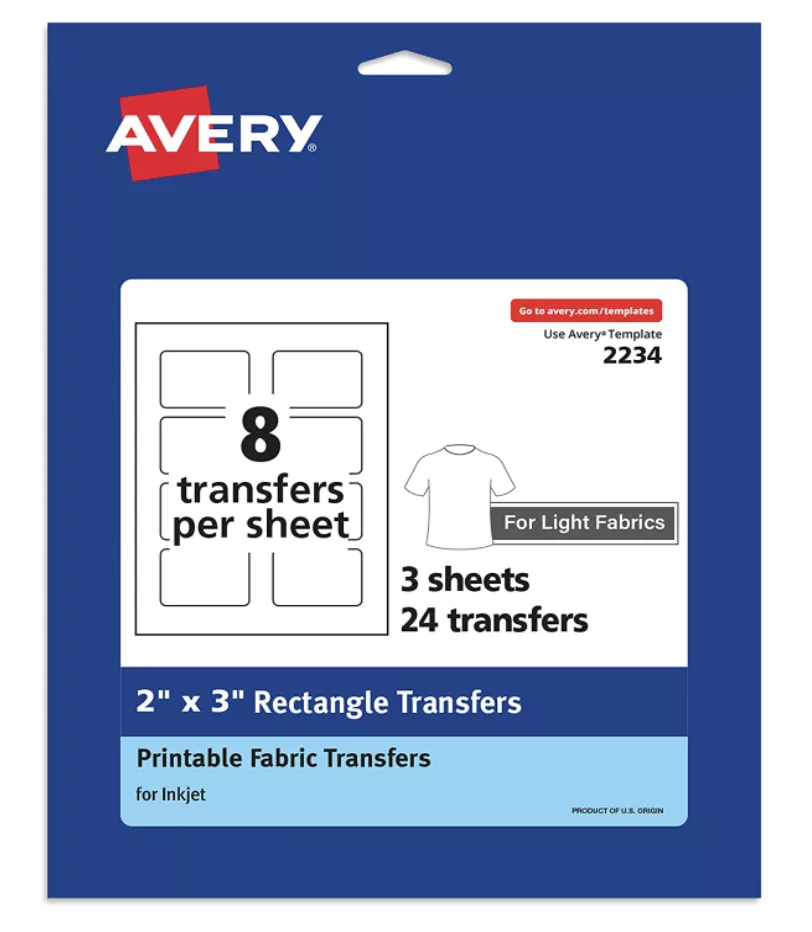
Avery 3275 is a straightforward starting point for a crafter using a home inkjet printer and a white or light-colored shirt. Avery’s current product documentation identifies the 3275 sheets as 8.5 x 11-inch light-fabric transfers for inkjet printers, with 12 matte sheets in the pack. The company says they are designed for light-colored 100% cotton or cotton/poly blends and can be applied with either a standard iron or a professional heat press.
The most important detail is that this is light-fabric transfer paper. Avery explains that the background of light transfers virtually disappears after application, which is why they work on white and pale fabrics but are not appropriate for a black shirt where the design needs an opaque white base. Avery’s light-transfer workflow also uses a mirrored design before application.
Best for: first-time transfer-paper users, white or light T-shirts, basic custom shirts, bags, and event apparel.
Printer: inkjet.
Fabric: light-colored 100% cotton or cotton/poly blends according to Avery.
Choose it if: you want clear manufacturer instructions and a common light-shirt workflow.
Skip it if: your shirt is black/dark, or you only have a laser printer.
For more detail, see our full Avery light-fabric transfer review. You can also check Avery’s current product specifications and application instructions.
Check Avery Light Fabric Transfers on Amazon
2. Silhouette Printable Heat Transfer for Dark Fabrics — Best for Contour-Cut Designs
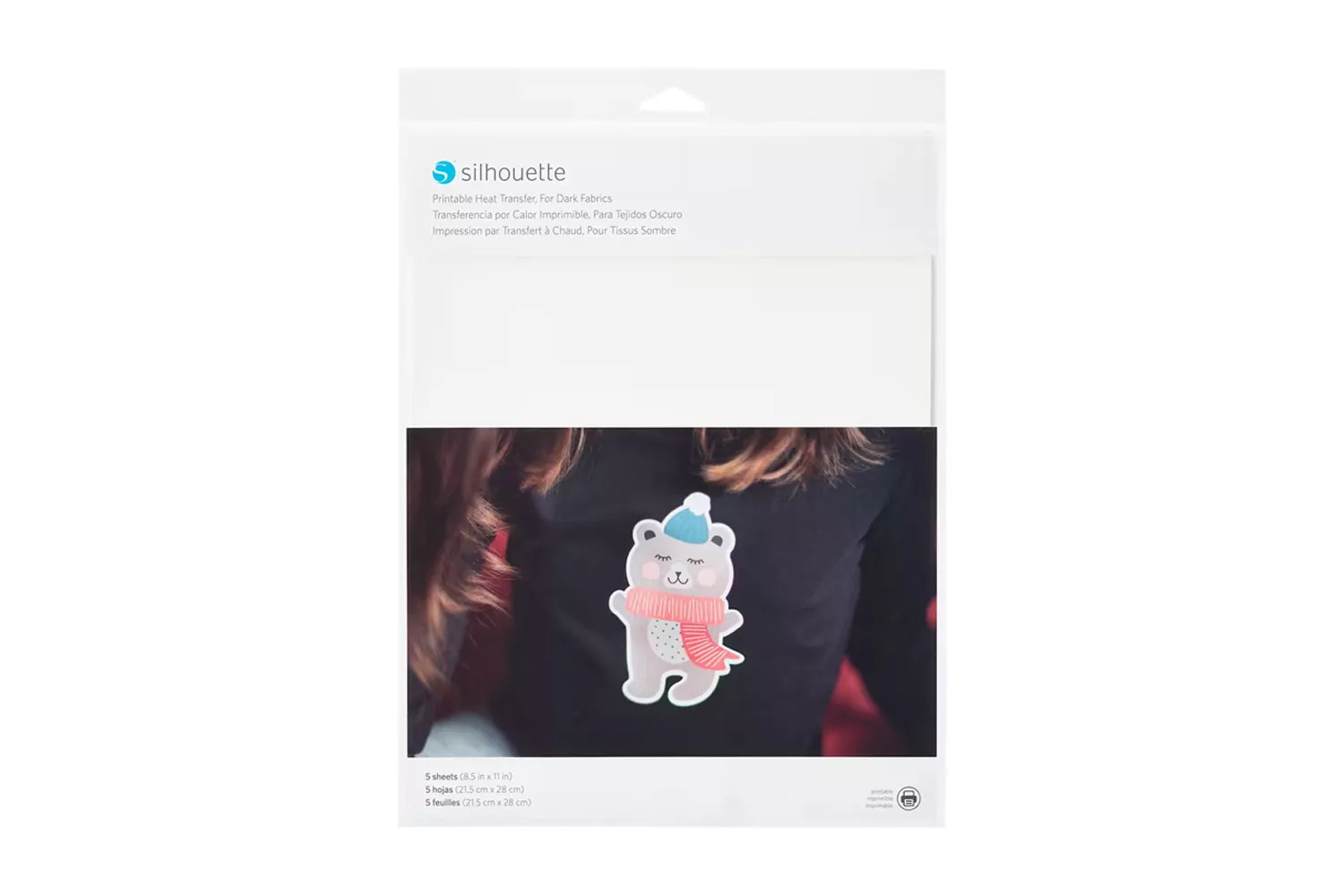
This Silhouette material makes the most sense when your priority is a printed design on a dark shirt that you also want to trim closely. The product in the original roundup is an inkjet-printable heat-transfer material for dark fabrics, sold in five-sheet packs. Because it is positioned as printable heat-transfer material rather than ordinary copy-style paper, the main advantage is the ability to cut around a design instead of leaving a large rectangle around the artwork.
I would avoid calling it “best for Cricut” without qualification. It comes from Silhouette, and cutter compatibility depends on the material, blade, software workflow, and settings. If you intend to use a Cricut or another cutter, confirm the current material instructions and perform a small cut test rather than assuming one setting fits every machine.
Best for: dark-shirt artwork that benefits from close contour cutting.
Printer: inkjet.
Fabric: dark fabrics according to the product positioning.
Choose it if: the visible border around a dark-fabric transfer is one of your main concerns.
Skip it if: you want a simple print-and-iron workflow with no cutting step.
If electronic cutting becomes a regular part of your projects, our die-cut machine guide can help you compare cutter options separately from transfer paper.
View Silhouette Printable Heat Transfer for Dark Fabrics product details
3. PPD Light Fabric Transfer Paper — Best for White & Light Shirts
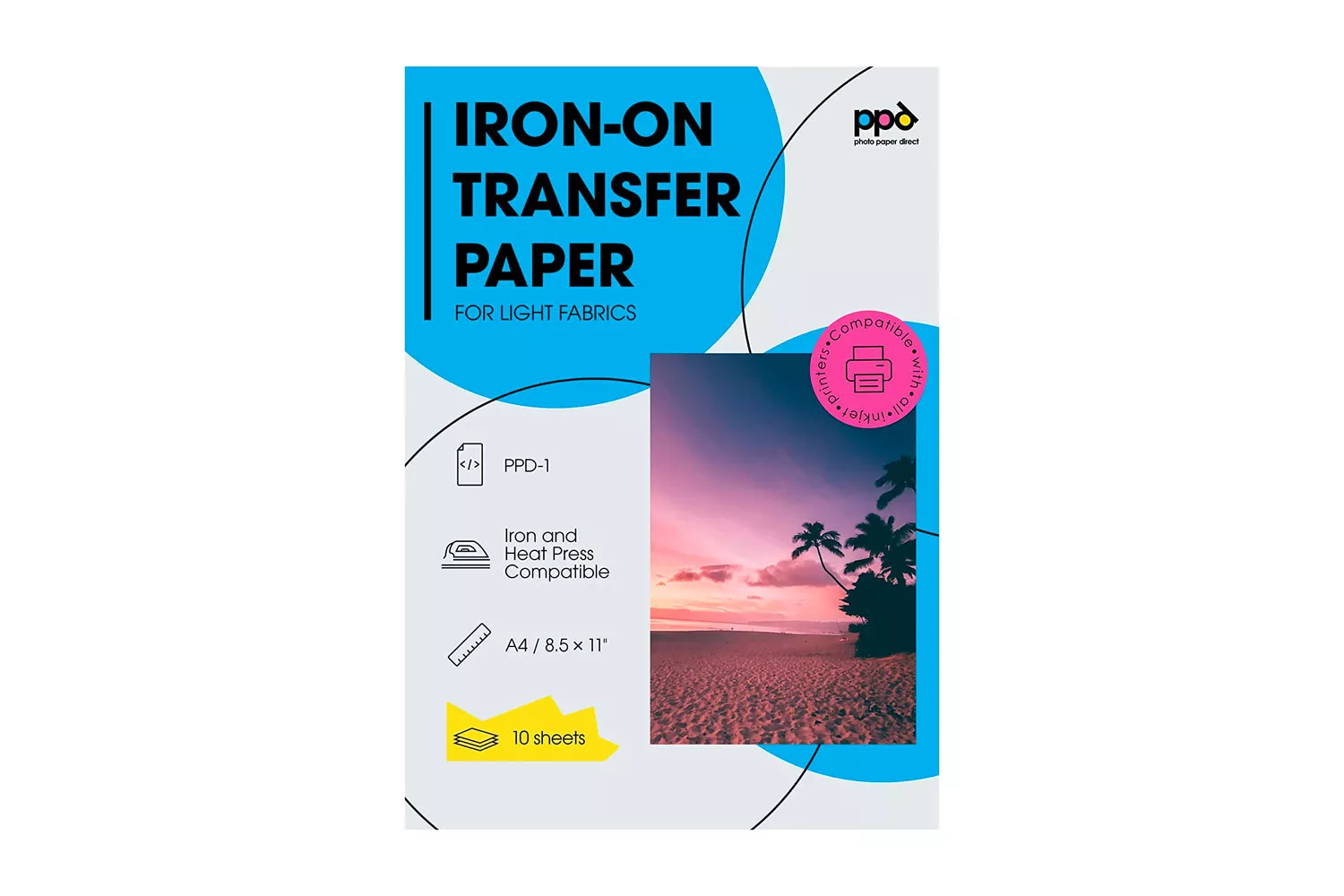
Photo Paper Direct’s light-fabric transfer paper is another option for white and pale shirts. The brand describes its current light transfer paper as compatible with inkjet printers and suitable for application with a standard iron or professional heat press. It is intended for light-colored fabrics and uses a clear-background approach, which helps the shirt color show through around parts of the design.
That clear-background behavior is useful when you want a design that does not look like a large opaque patch, but it also explains why light transfer paper is a poor match for black fabric. Dark fibers can show through areas that are supposed to look white or bright.
Best for: white/light shirts, photo-style designs, and DIY projects where a less-visible background is desirable.
Printer: inkjet.
Fabric: white/light fabrics; verify the exact fiber compatibility on the pack you buy.
Choose it if: you want a conventional light-shirt transfer workflow.
Skip it if: your main projects use black, navy, or other dark shirts.
Photo Paper Direct also notes that its light-fabric paper can be used with cutting machines. See the manufacturer’s current light-transfer information for the exact product you plan to buy.
Check PPD Light Fabric Transfer Paper on Amazon
4. JET-PRO SoftStretch — Best for a Softer Light-Fabric Transfer

JET-PRO SoftStretch is the option in this roundup to compare when you want an inkjet transfer for a light garment but are especially concerned about the transfer feeling too rigid. The current article originally made very strong claims about wash performance and fade resistance; I would not keep those claims unless Craft Ideas has its own documented testing or a current manufacturer statement that supports them.
Instead, treat JET-PRO as a light-garment inkjet option with a soft/stretch-oriented positioning. That makes it relevant for wearable projects where the feel of the finished area matters, but application details such as temperature, pressure, peel timing, and washing should come from the instructions supplied with the exact pack you purchase.
Best for: light garments when a softer transfer feel is a priority.
Printer: inkjet.
Fabric: light garments; confirm the current product instructions for fiber limits.
Choose it if: you are comparing light-fabric papers by flexibility rather than only price.
Skip it if: you need a dark-shirt product or a laser-compatible sheet.
Check JET-PRO SoftStretch on Amazon
5. PrintWorks Dark Fabric Transfers — Best for Dark Shirts

For a black, navy, red, or other colored shirt, PrintWorks is the clearest dark-fabric pick in this roundup. The manufacturer says its Dark Fabric Transfers are made for inkjet printers and can be used on colored as well as white/light 100% cotton or cotton/poly blend fabrics. The transfer itself is opaque white, so blank areas in the design remain white after application.
That opaque base is exactly what makes dark-fabric paper work, but it also creates one of the most common visual problems: an unwanted white border. Trim close to the artwork when the design calls for it, and remember that dark-transfer workflows do not necessarily use the same mirroring and peel process as light-transfer sheets.
Best for: black and dark-colored shirts using an inkjet printer.
Printer: inkjet only according to PrintWorks.
Fabric: colored or white/light 100% cotton and cotton/poly blends.
Choose it if: you want an opaque transfer so colors remain visible on a dark shirt.
Skip it if: you only have a laser printer.
Read PrintWorks’ current product guidance before pressing. Craft Ideas also has a separate Avery dark-fabric transfer review if you want to compare another dark-shirt approach.
Check PrintWorks Dark Fabric Transfers on Amazon
6. Premium Red Line Laser Transfer Paper — Laser-Compatible Pick in This Roundup
Most of the products in this list are inkjet materials. Premium Red Line is here for a different reason: the product already covered by the original article is sold as a laser-printer transfer paper for dark fabrics. If you own a laser printer, that distinction matters more than any “best overall” label.
Laser transfer papers can have more specific printer and heat requirements than a casual product title suggests. Because reliable manufacturer documentation for this exact Red Line listing is less accessible than the documentation available for Avery, PrintWorks, NuFun, or PPD, I would treat the package instructions as mandatory rather than making broad claims such as “works with every laser printer” or promising compatibility with every fabric.
Best for: shoppers who specifically need a laser-compatible option and have confirmed the current product instructions match their equipment.
Printer: laser, based on the product sold in the existing roundup.
Fabric: check the exact listing/package before ordering.
Choose it if: you cannot use the inkjet products above.
Skip it if: your printer model or application setup is not explicitly supported.
Check Premium Red Line Laser Transfer Paper on Amazon
7. NuFun Light & Dark Combo Pack — Best for Mixed Projects

NuFun’s combo pack is useful when you regularly switch between light and dark garments and do not want to buy two separate packs immediately. The current manufacturer page says the set contains both light- and dark-fabric transfer papers and can be applied with a household iron or heat press.
There is an important compatibility detail that is easy to miss: according to NuFun, the light sheets are for inkjet printers only, while the dark sheets are compatible with both inkjet and laser printers. In other words, “combo pack” does not mean every sheet inside it works in every printer. Treat the light and dark instructions as separate processes.
Best for: crafters who make shirts in several colors.
Printer: light sheets: inkjet; dark sheets: inkjet or laser, according to NuFun.
Fabric: light and dark fabrics using the corresponding sheet type.
Choose it if: you want one purchase that covers several shirt colors.
Skip it if: you only make one type of shirt and would rather buy a more specialized pack.
See the NuFun product documentation for current compatibility details.
Check NuFun Light & Dark Combo Pack on Amazon
Best Transfer Paper for Dark Shirts
For dark shirts, use a transfer paper specifically designed to keep printed colors visible over a dark background. These papers normally include an opaque white layer. That layer solves the visibility problem, but it means any unprinted area you leave around the artwork can remain visible after pressing.
Within this roundup, PrintWorks Dark Fabric Transfers are the clearest inkjet option for black and colored shirts because PrintWorks explicitly documents their use on colored fabrics and cotton/cotton-poly blends. The Silhouette dark-fabric printable material is worth comparing when close contour cutting is part of your workflow. NuFun’s dark sheets are another flexible option, especially if you also make light-shirt projects.
Common dark-transfer problems include:
- Visible white border: trim around the artwork more closely or use a cutter when the material supports it.
- Stiff hand feel: large solid transfer areas naturally feel more noticeable than smaller, well-trimmed graphics.
- Poor adhesion: insufficient heat, pressure, incorrect surface, or incorrect timing can prevent a proper bond.
- Cracking or peeling: application errors, stretching, washing, drying, and the paper itself can all contribute.
- Dull color: confirm that you are using dark-fabric material rather than transparent light-fabric paper.
Check PrintWorks Dark Fabric Transfers on Amazon
Best Transfer Paper for Light Shirts
White and pale shirts are where light-fabric transfer paper makes the most sense. Instead of relying on an opaque white backing, the transfer background becomes far less noticeable so the shirt itself acts as the light base behind the printed color.
Avery 3275 and PPD’s light-fabric paper are the easiest options in this list to understand for this use case. Avery documents the 3275 as an inkjet product for white/light 100% cotton or cotton/poly blends, while PPD markets its light transfer paper for inkjet printing and iron or heat-press application.
Mirroring is another key difference. Avery instructs users of its light transfers to print a mirrored design, while its dark-transfer workflow does not require the same reversal. Do not memorize “always mirror” as a universal rule: follow the instructions for the specific transfer paper you have.
Check Avery Light Fabric Transfers on Amazon
Inkjet vs. Laser Transfer Paper
| Question | Inkjet transfer paper | Laser transfer paper |
|---|---|---|
| Printer required | Inkjet | Compatible laser printer |
| Common in this roundup | Most products | Premium Red Line; NuFun dark sheets also state laser compatibility |
| Light/dark choices | Widely available | Depends heavily on product |
| Can you substitute one for the other? | No. Only use the printer type the manufacturer specifies. | |
| Beginner advice | Usually the simplest home-printer route if you already own an inkjet | Confirm exact printer and paper compatibility before ordering |
The most important rule is simple: do not run inkjet-only transfer paper through a laser printer just because the sheet is the same size. Printer technologies use different heat and printing processes, and the paper coating has to be designed for the printer.
How to Choose the Best T-Shirt Transfer Paper
Check your printer first
Before looking at price, sheet count, or reviews, confirm whether you have an inkjet or laser printer. Most of this roundup is aimed at inkjet users. If you have a laser printer, your shortlist becomes much smaller.
Choose light or dark fabric paper
Light transfer paper is generally less visible around the design but relies on the light-colored shirt as part of the finished appearance. Dark transfer paper adds an opaque base so colors and white areas can show on black or colored shirts. Buying the wrong type can make an otherwise good print look weak or leave unexpected borders.
Check fabric compatibility
Do not assume every transfer works on cotton, polyester, canvas, stretch fabric, and blends equally well. For example, Avery’s light-transfer documentation focuses on light-colored cotton and cotton/poly blends, while PrintWorks specifies cotton and cotton/poly blends for its dark transfers. Follow the exact product documentation rather than a generic temperature chart.
Household iron vs. heat press
A household iron is convenient for occasional DIY shirts and works with products that explicitly support iron application. A heat press gives more consistent control over pressure, temperature, and time, which becomes more useful when you make many shirts. Either way, the correct settings come from the paper manufacturer—not from a universal recipe.
Think about wash durability without chasing unrealistic claims
Cracking, peeling, and fading are influenced by the paper, but also by application pressure, heat, washing, drying, fabric stretch, and whether the care directions were followed. Avery, for example, states that its fabric transfers are guaranteed to look good after 20 washes when applied and washed according to instructions. That does not mean every transfer paper in this roundup carries the same claim.
Consider cutting and peeling
If your artwork has an irregular outline, the ease of trimming can matter almost as much as print quality. Dark-fabric transfers often make unprinted white areas visible, so a cutter can produce a cleaner edge. If this becomes a major part of your workflow, compare the machines in our craft cutting machine guide.
How to Use T-Shirt Transfer Paper
The exact instructions differ by brand, so use this as a planning checklist rather than a replacement for the package directions:
- Match the paper to your shirt color and printer. Confirm light vs. dark fabric and inkjet vs. laser before opening the pack.
- Prepare the artwork. Size the design for the shirt and check whether the product requires mirroring.
- Print a plain-paper test first. This helps catch size, orientation, spelling, and color problems before you use a transfer sheet.
- Print on the correct side of the transfer paper. Feed one sheet at a time if the instructions recommend it.
- Trim the design if needed. This is especially important on dark-fabric paper where unused white backing may remain visible.
- Prepare the garment and work surface. Remove wrinkles and moisture according to the manufacturer’s directions.
- Apply the transfer using the stated heat, pressure, and time. Do not copy settings from another brand just because both are called transfer paper.
- Peel at the correct stage. Some processes are hot, warm, or cold peel; follow the actual product instructions.
- Follow the care instructions before washing. Waiting time, wash temperature, detergent, turning the shirt inside out, and dryer settings can affect the result.
Avery’s light-transfer instructions are a good example of why brand-specific directions matter: the company specifies mirroring, an iron with steam turned off, a heat-resistant surface, and separate heat-press settings. Another product may use a different workflow entirely.
Transfer Paper vs. HTV vs. Sublimation vs. DTF
| Method | Best suited to | Printer/equipment | Main reason to choose it |
|---|---|---|---|
| Printable transfer paper | Home DIY and small custom runs | Inkjet or laser depending on the paper; iron or heat press | Accessible with common home equipment |
| HTV | Cut shapes, text, logos, layered vinyl designs | Cutting machine/manual cutting + heat | Good for solid-color cut graphics |
| Sublimation | Compatible light polyester/substrates | Sublimation printer/ink + heat press | Ink becomes part of a compatible surface rather than sitting as a transfer layer |
| DTF | Broader garment-printing workflows | Specialized DTF printing/transfer process | Useful for detailed full-color apparel printing |
If your goal is simply to personalize a few cotton T-shirts with a printer you already own, printable transfer paper is often the lowest-friction place to start. If you want solid-color names and logos, HTV may be simpler. Sublimation and DTF deserve their own workflows and should not be treated as just another brand of iron-on paper.
For a low-equipment alternative to transfer paper, you can also compare our fabric marker recommendations for T-shirts and cotton.
How We Chose These Transfer Papers
This update does not claim that Craft Ideas personally washed every transfer a fixed number of times or tested every pack on the same printer. Instead, the seven products were retained from the existing roundup and reevaluated using the factors that matter most for a buying decision:
- printer compatibility;
- light vs. dark fabric use;
- manufacturer-stated fabric compatibility;
- household iron or heat-press support;
- cutting and trimming requirements;
- clarity of official instructions;
- suitability for typical DIY T-shirt projects.
Where reliable manufacturer documentation was available, I used it to correct or qualify older claims. Where documentation for an exact listing was limited, the recommendation is deliberately more cautious rather than filling the gap with an unverified promise.
Frequently Asked Questions
What is the best transfer paper for shirts?
The best transfer paper depends first on your printer and shirt color. For a white or light shirt with an inkjet printer, Avery 3275 or another light-fabric inkjet paper is a practical starting point. For a dark shirt, use an opaque dark-fabric transfer such as PrintWorks. Laser users need paper specifically marked for laser printing.
What is the best transfer paper for dark T-shirts?
For dark T-shirts, choose paper specifically designed for dark fabrics so the transfer includes an opaque base. In this roundup, PrintWorks Dark Fabric Transfers are the clearest inkjet choice because the manufacturer explicitly supports colored fabrics and cotton/cotton-poly blends. Silhouette’s dark printable material is worth considering when contour cutting is important.
Can I use an inkjet printer for T-shirt transfer paper?
Yes, many common T-shirt transfer papers are designed for inkjet printers, including Avery 3275, PrintWorks Dark Fabric Transfers, PPD light transfer paper, and the light sheets in NuFun’s combo pack. Always verify the package because a laser-only product should not be substituted into an inkjet workflow, and vice versa.
Can I use a regular household iron?
Yes, if the paper manufacturer supports iron application. Avery, PPD, PrintWorks, and NuFun all offer transfer products with household-iron workflows. Use the heat-resistant surface, pressure, timing, steam setting, and peel method stated by the specific product rather than relying on a generic setting.
Do I need to mirror the image?
It depends on the transfer process. Avery instructs users to mirror designs for its light T-shirt transfers, while its dark transfers do not use the same mirrored workflow. Treat “mirror” as a product-specific instruction, not a universal rule.
Can transfer paper be used on 100% cotton shirts?
Many transfer papers are designed for cotton, but compatibility varies by product. Avery specifies 100% cotton or cotton/poly blends for its light transfers, and PrintWorks gives similar guidance for its dark transfers. Check the exact pack before applying it to polyester, stretch fabrics, or specialty textiles.
Why does transfer paper crack or peel after washing?
Cracking or peeling can come from insufficient heat or pressure, incorrect timing, stretching, the wrong fabric, or washing/drying outside the care instructions. Product quality matters too, but correct application and aftercare are part of durability. If a transfer starts failing early, review the original product instructions before increasing heat randomly.
Is transfer paper better than heat-transfer vinyl?
Neither is universally better. Printable transfer paper is convenient for full-color images and photos using a compatible printer. HTV is often easier for solid-color text, names, shapes, and layered cut designs. Choose the process based on the design you want to make and the equipment you already own.
Bottom Line: Start With Shirt Color + Printer Type
If you are still unsure what to buy, do not start with the brand name. Start with the shirt and printer sitting in front of you. Inkjet + light shirt points toward Avery or PPD. Inkjet + dark shirt points toward PrintWorks or another opaque dark-fabric sheet. Mixed shirt colors make NuFun’s combo format useful. Laser printer means you should ignore most inkjet-only picks and verify a laser-specific product before buying.
That simple decision framework prevents more wasted paper than choosing whichever package has the highest star rating. Once you know the technology matches your project, compare pack size, cutting workflow, application method, and price.
Explore more comparisons in Craft Ideas’ Best Craft Products.